This will likely be an ongoing subject about which I am doing some research into the justification of Natural Law (NL) theory and the historical moments in which we might see civilization's departures from it. Principally, I am concerned with the relationship of the State and its citizen to NL and to each other. The subject of co-belligerence becomes relevant if we can trust in a universal NL. It is to the existence of such a law which I will turn attention first.
There are several ways one might try to justify the existence of NL. Without pretense to exhaust the subject of justification, I will make a survey of generalities:
1. Biblical Justification - concerning those for whom the Bible is the divinely inspired interpretation of all fact.
2. Religious justifications in general - including a brief survey of comparative theistic religions as based in an epistemic revealed text.
3. Atheistic/Agnostic Justification - here Buddhism, materialism (dialectical and empirical), and meta-naturalism are considered.
The first two categories would seem to have little epistemic common ground with the latter. However, my study in natural law is only peripherally concerned with the justification of belief (i.e. the evaluation of the epistemic warrant). I hope to give some account of natural and non-natural views, both of which conceive of a "natural law", in this study of meta-ethics. The universality of legal premises is the main subject of inquiry here. It is on these lines that I would like to introduce the study by way of a distinction between pragmatistic legal positivism and NL (as derived from "natural" and "non-natural" justification). If this sounds confusing, it is because NL theorists hold that a law may be natural, self-evident, or innate while at the same time being derived either empirically ("naturally") or metaphysically ("non-naturally"). The use of "nature" as descriptive changes according to the context. For the sake of simplicity, all laws conceived as self-evident transcendent principles will be called NL.
The pragmatist need look no further than interest to justify policy. As such, the dominant rhetoric of foreign policy debates focuses on the "national interest". A NL theorist, on the other hand, looks to a transcendent moral principle. It doesn't escape me that the rhetorical nuance of many pragmatists is to equivocate moral principle with individual or corporate interest. I reserve the right to be skeptical of the equivocation. Pragmatism is the dominant paradigm of epistemology in the public square, it seems. The intellectual roots of Western pragmatism are well articulated in Aristotle's Rhetoric. In it, the Philosopher makes a case that popular rhetoric need not be true in any absolute sense if it accomplishes the ends of garnering public support. I am using a fairly cynical definition of pragmatism here (ends justify means), but I think it will bear out as we see its application in the arguments for public policy.
The NL theorist (here used synonymously with a kind of idealist) ideally remains agnostic as to the accomplishing of ends or even the pre-emptive moral justification of those ends. Rather, he/she is eminently concerned with the justification of means. For this reason, some NL adherents might be caricatured as curmudgeonly toward progress and productivity. If we must always have an immediate moral justification for each means in solution of large-scale problems, then we will inevitably move too slowly to act decisively or even in a timely way. Deliberation may be a vice in itself if action fails to meet the demands of time.
When the preceding distinction is made and maintained, there is the potential of a stark moral contrast between idealists and pragmatists. Though both may arrive at the same conclusion in policy, there appear no grounds on which it might be said commonality is a predictable outcome. It might be that the greater of the "culture wars" and "clash of civilisations" is between these disparate epistemologies. If this is the case, the so-called "War on Terror" may have very different origins than the popular notion of a clash of two ideological and idealistic foes battling for whose NL will prevail.
The advantage in studying epistemic generalities as we will do here is that one need not have all variables available in order to analyse and critique. The epistemic starting place will offer its own justification of means. Our task will be to consider the coherence of policy, leaving the conscience free to chose the epistemic grid. Of course, I lack the capacity for total objectivity, so I will conclude the series (and you may see it along the way) with my own evaluation of the moral justification of NL vs. Pragmatism.
Tuesday, December 9, 2008


Monday, December 8, 2008
Public domain and property
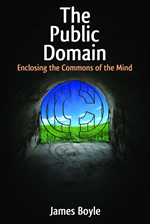 http://yupnet.org/boyle/archives/17
This is a link to the preface of a free online book about the importance of the public domain and the infringements on it by the trajectory of existing copyright law. I thought it was provocative and well worth considering. The implications are vast: what of a world where everything is "owned"? I often draw from out-of-print material and the public domain in my studies. likewise from used books long traded beyond the reach of royalty agreements. Should we close down the sale of used books to "protect" the interests of "intellectual property" owners? What about those resources that hardly anyone knows exist, locked in a vault under the "protection" of copyright law, sometimes called "orphaned works"? What of ideas whose consequences are earth-shattering, which will never see the light of day once they are retired out-of-print. I think this could lead to a new dark age. Think about the Catholic monopoly on thought during the last dark age. It isn't a pretty picture.
Many "free-marketeers" stress private property as supreme. After all, privatization is the only conceivable incentive to produce and innovate, right? But on what is innovation built? A new idea is a new analysis of a fact in the public domain. Once produced, the new analysis becomes the subject of further analysis, or at least it should. If ideas can be monopolized indefinitely, they are taken off the table of scrutiny.
The same dilemma concerns commodities like land, energy resources, gold, food, etc. Is there not a common source of all? How does that common source effect the ethos of ownership? Monopolization? Exclusive license? Profit? Not easy questions, to be sure, but needful if we would claim to have a developed ethical theory. It seems most are satisfied to let court rulings and "experts" dictate these matters, but I beg to differ. This issue touches on the mundane for each of us. Words of paralysing wisdom from Socrates urge us to "examine" a life worth living. In an age of high productivity and cheap accreditation (not inexpensive, but of dubious value), such work might grind progress to a momentary halt. Examination is to think before we act. Examination is to think about our actions. Examination is to consider our actions retrospectively and to repent when necessary.
Subscribe to:
Posts (Atom)